Skip to content

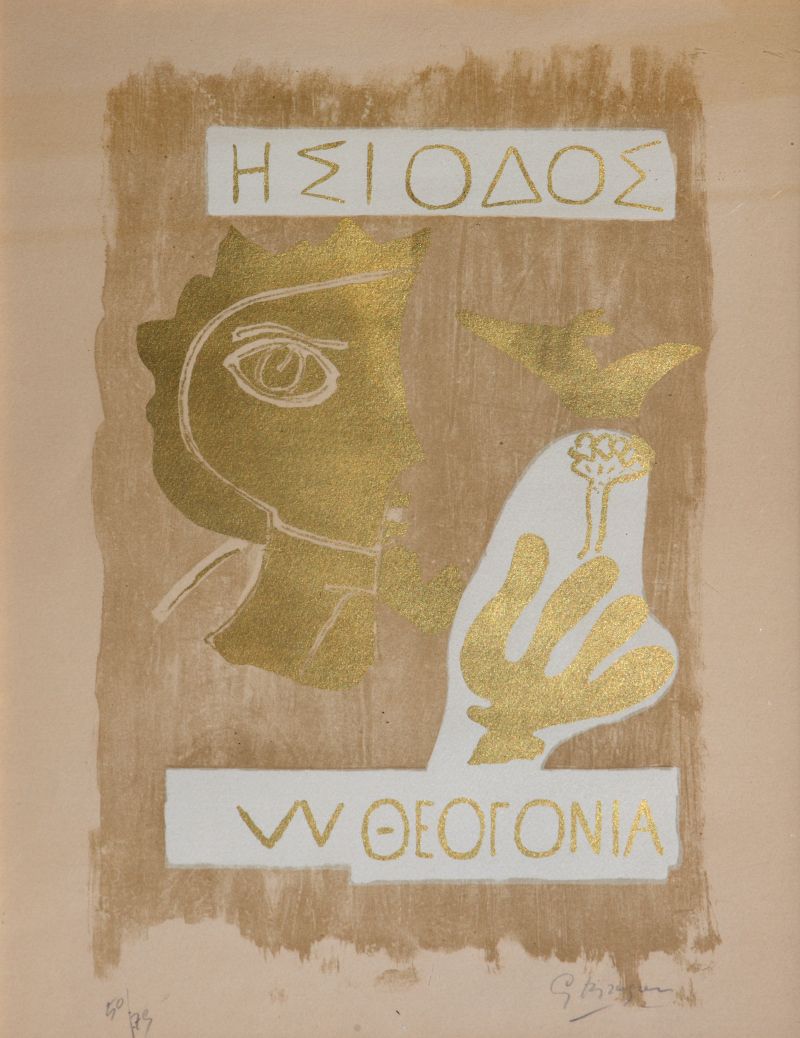
Hesiod Theogony Greek Text Lithograph, 1954

Estimated price$7,000 – $13,000

Lithograph In Gold Ink On Auvergne Paper French

37 × 48 cm | 14.6 × 18.9 in

Certificate of Authenticity

A Certificate of Authenticity (COA) is a signed document verifying that this artwork is the genuine work of the named artist. For pieces from the Hindiyeh Collection, the COA is signed by the collection. For gallery- or artist-direct pieces, it is issued by the gallery or by the artist's authorized estate.

The COA includes the artist's name, the title, year, medium, and dimensions of the work, and is delivered with the artwork at the time of dispatch.

Rarity classifications

Unique
A one-of-a-kind work. No other version of this piece exists.

Limited edition
The artist or their estate produced a known, finite number of copies. The edition size is shown in the work's details.

Open edition
The edition run is ongoing. New works may still be produced in the same series, which may be numbered or made to order.

Unknown edition
The edition has ended, but the number originally produced is no longer documented.


Request this piece
About the price estimate

The price shown is an estimated range based on the work's medium, year, edition status, and current market context. It is not the final sale price.

Once you submit an inquiry, an Artsamy specialist will confirm the exact price for this piece alongside shipping, insurance, and any other costs. The final figure may fall within the estimate, slightly below for first-time buyers or aged listings, or occasionally above for highly contested works.

If you believe the estimated range is inaccurate, or you'd like to discuss the valuation directly, contact us and a specialist will respond within six hours during business days.

Shipping & taxes

Ships from Amman, Jordan. Hand-packed in a custom crate or rigid art-tube depending on medium and size.

Delivery (after handling): 5–10 business days within MENA, 10–18 to Europe and North America, 14–25 elsewhere. Larger or framed works ship via fine-art freight; timing confirmed by email after purchase.

Duties & taxes are excluded from the price. International buyers are responsible for any customs fees on arrival. Full export documentation provided.

Works leaving Jordan require an export clearance certificate, arranged on your behalf.

Need a quote first? Contact us with your delivery city.

The Artsamy guarantee
  • Secure checkout. Payments are encrypted and processed by Shopify Payments.
  • Authenticity guaranteed. Every artwork ships with a signed Certificate of Authenticity, verified by the artist or their estate.
  • Money-back guarantee. 14-day return window if the artwork doesn't match its listing or arrives damaged in transit.
  • Learn more about the Artsamy guarantee →

About the work

A gold-ink lithograph depicting a stylised face, a bird in flight, and an outstretched hand amid Greek inscriptions reading 'Hesiodos' and 'Theogonia,' rendered in warm golden tones against a soft brown and white ground. The composition blends Cubist fragmentation with ancient Greek visual language, creating a ceremonial and mythological atmosphere.

Georges Braque (France, 1882–1963).

Lithograph In Gold Ink On Auvergne Paper French, 48 × 37 cm, 1954.

Part of the permanent collection of the Hindiyeh Museum of Arts, Jordan. Signed and editioned 50 /75 .

Medium
Size
37 × 48 cm | 14.6 × 18.9 in
Year
1954
Edition
50 /75
Rarity
Limited Edition
Certificate of authenticity
Included
Genre
Colours
Brown, Yellow, Grey
Location
Amman, Jordan

About the artist

Georges Braque — Lithograph , 80 × 60 cm (representative image)
Georges Braque

France, b. 1882–1963

Georges Braque (1882–1963) was a seminal French artist renowned for co-founding Cubism alongside Pablo Picasso. Born in Argenteuil, France, he initially trained as a house painter before studying at the École des Beaux-Arts in Le Havre. Braque's early works were Impressionistic, but after encountering the Fauvist movement in 1905, he adopted their vibrant color palette and expressive forms. By 1907, influenced by Paul Cézanne's retrospective, Braque's style evolved towards geometric abstraction, leading to the development of Cubism. His collaboration with Picasso from 1909 to 1914 was pivotal, as they jointly explored fragmented perspectives and multiple viewpoints, challenging traditional artistic conventions.

Braque's contributions to Cubism are exemplified in works like "Houses at L'Estaque" (1908) and "Violin and Palette" (1909). His first solo exhibition in 1908 at Daniel-Henry Kahnweiler's gallery marked his emergence in the art world. After World War I, during which he was severely injured, Braque's style softened, incorporating more color and recognizable forms. He continued to innovate, integrating elements like sand and sawdust into his paintings to enhance texture. In the 1920s, Braque expanded his repertoire to include sculpture and stage design, notably creating sets for the Ballets Russes. His work was celebrated in major exhibitions, including a significant retrospective at the Salon d'Automne in 1922.

Braque's market presence was solidified with international acclaim, winning first prize at the Carnegie International in Pittsburgh in 1937. His works are held in prestigious institutions worldwide, reflecting his enduring influence on modern art. Braque passed away on August 31, 1963, in Paris, leaving behind a legacy that continues to inspire artists and art enthusiasts alike.

View all works by Georges Braque

Printmaking

Images made by transferring ink from a prepared surface — etching, lithography, screenprint, woodcut — usually in limited editions. Iraqi artists such as Rafa Nasiri helped make printmaking a serious modern art form across the Arab world.

Cubism

A revolutionary early-twentieth-century approach that fractures objects into geometric planes and multiple viewpoints at once. Arab artists such as Jamil Hamoudi adapted its geometry to calligraphic and regional themes.